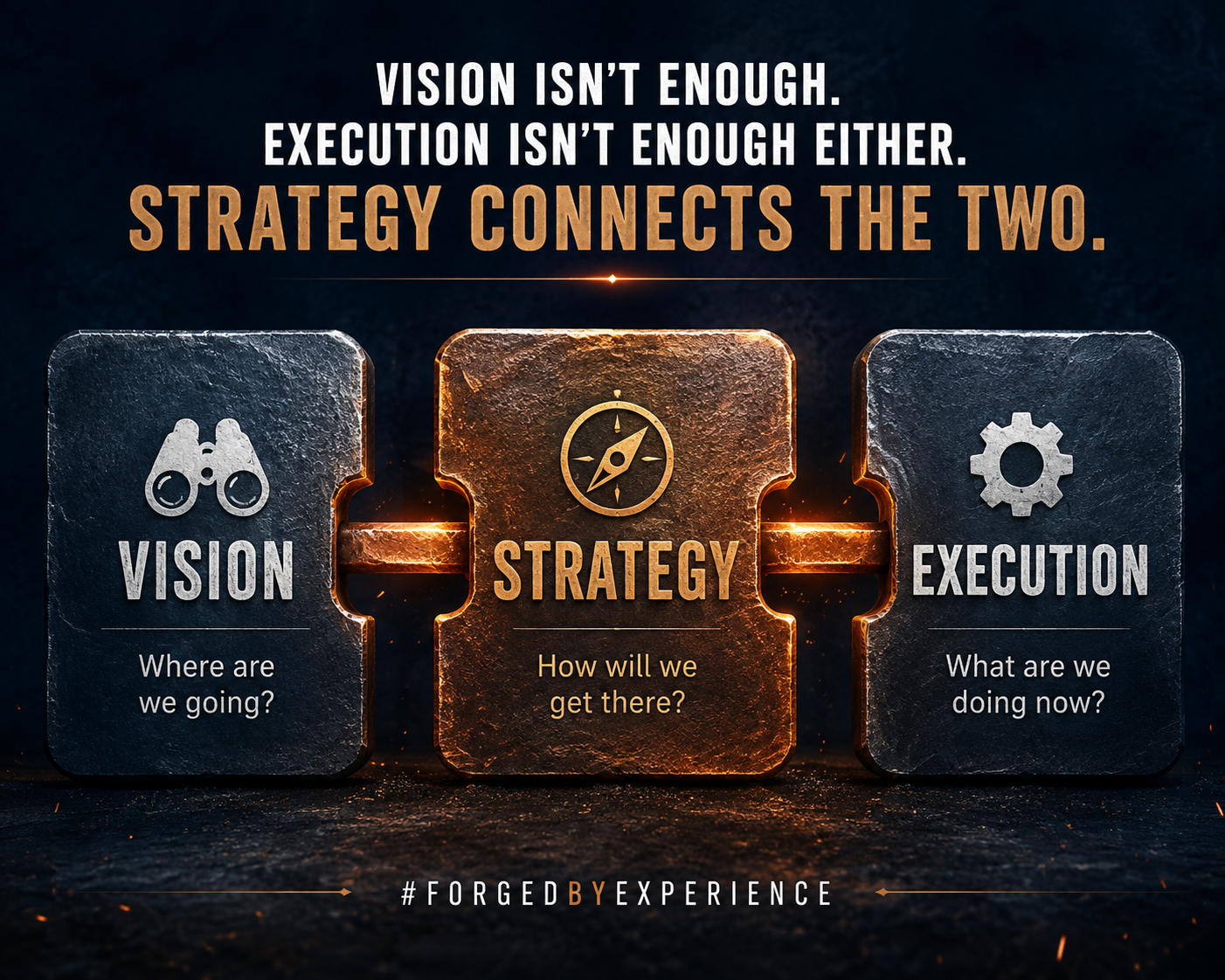
Strategy connects vision to execution.

Vision tells you where you want to go. Execution is the work happening today. Strategy connects the two.

At a 35-year-old organization, much of the strategy lived in the minds of strong leaders. When those leaders moved on, there was an opportunity to make that direction visible to the whole organization and board.

Our first attempt in Excel became complicated, difficult to maintain, and harder to understand. We moved to strategic planning software, built a framework, and kept changing it. The content, structure, and approach evolved every year as we learned what was useful.

A useful plan gives leaders a way to choose priorities, assign accountability, and see how daily work contributes to the bigger picture. Its value grows when it becomes a management tool rather than a document on a shelf.
Start with a useful plan. Learn from it. Refine it.
Back to all insights ↑
Vision and execution connected by strategy, illustrated with three industrial steel blocks.
From the Forge Advisory graphic series. Select the graphic to view it at full size.

Build the bench before you need it.

The worst time to start thinking about your next leader is the day your current one walks out the door.

At the director level, I experienced intentional development firsthand. My leader encouraged my strengths, celebrated my wins, and addressed my gaps through honest conversations. He was preparing me for what came next before either of us knew when that opportunity would arrive.

When an opportunity took him out of state sooner than expected, the CEO told me within a couple of days that she knew who could step in. The organization had already been developing its next leader.

Succession planning means investing in people now, giving them feedback, experience, and trust so they are ready when a future possibility becomes an immediate need. Who are you developing today to take on more tomorrow?

Develop the next leader before a vacancy forces the decision.
Back to all insights ↑

One useful measure can create clarity.

Every leader has the same basic assignment: make something better. The harder question is where to start.

Overseeing ten cost centers in Operations, I needed a shared starting point. Different functions had different objectives, processes, and measures. But all contributed to one outcome: food getting shipped out our doors.

Cost per pound distributed became the top-level KPI. It let me see whether performance was improving, then ask why. From there, we broke the measure down by function and process until the drivers became visible.

Across years of improvement, operating expenses decreased 24% while distribution volume increased 15%. The benefit went beyond the numbers. Leaders could explain priorities, teams understood how their work contributed, and accountability became more objective.

Organization → Function → Process. Start with the outcome, then follow the drivers.
Back to all insights ↑

Technology reveals the work you still need to do.

95% accuracy sounds pretty good, until five of every hundred cases in a fulfillment operation are wrong.

A new Warehouse Management System and RF picking technology gave us visibility into problems we had not fully understood: inventory inaccuracies, process gaps, inconsistent practices, and workarounds that had become normal.

Some shortcuts felt faster. They also made us less accurate. We corrected inventory, standardized processes, removed workarounds that hurt performance, and helped the team understand why the changes mattered.

Picking errors fell from roughly five per hundred cases to an average of 1.5, a 70% reduction. The technology was valuable, but the improvement came from what we did with the visibility it gave us.

Bring people, processes, and technology into alignment.
Back to all insights ↑

Investment needs a strategy.

Investment without strategy can become expensive infrastructure.

On my first tour of a facility, I was impressed by the automation. I assumed it must be central to the distribution operation. Over time, I noticed that equipment designed to operate around the clock was often sitting idle.

The problem was not simply the equipment. The organization had not developed a clear plan for using it effectively. Excitement about the technology had moved faster than the strategy, adoption, and operating model needed to support it.

Before making a major investment, research it, bring the right people into the discussion, challenge assumptions, and agree on what success looks like. Know how the investment moves the organization toward its goals.

Even impressive technology cannot execute a strategy that does not exist.
Back to all insights ↑

Give good ideas somewhere to live.

Inspiration does not always survive the return to a full inbox and a busy operation.

After a conference, it is easy to come home with a long list of ideas. Then everyday demands return, and useful ideas can disappear under an already-full plate. I have let that happen, too.

Take notes that will still make sense later. Bring the ideas into one place, then evaluate them against your strategy, capacity, available resources, and the outcomes you want. Identify who would need to participate and what implementation would require.

Sometimes the most valuable decision is choosing what not to do. A shorter list of clear priorities gives your best ideas a realistic chance of becoming action.

Turn an overflowing list of possibilities into a practical next step.
Back to all insights ↑
A forging hammer and sparks with the statement Forging clarity from complexity.
From the Forge Advisory graphic series. Select the graphic to view it at full size.

Rethink the route, improve the service.

Distance should not determine whether a food pantry can access the service it needs.

At the Regional Food Bank of Oklahoma, a route serving the Oklahoma Panhandle stretched roughly 650 miles round trip. Driving, loading, unloading, and service time meant the traditional model required an overnight stay for the driver.

Redesigning how partners were served created a more practical operation and improved access, including more frequent deliveries and more fresh produce.

Innovation often begins by questioning a familiar constraint. What if we designed around the outcome we wanted, then rebuilt the route to support it? The strongest operational change improves the experience for the people doing the work and the people being served.

Design around the outcome, then rebuild the operation to support it.
Back to all insights ↑

Develop leaders who develop others.

Watching young athletes develop is a reminder of what people need to grow: practice, coaching, feedback, repetition, and real experience.

Over a season, decisions become faster. Confidence grows. Players learn to anticipate the next situation and trust one another. Small corrections can help someone discover a capability they did not know they had.

Developing people at work follows a similar pattern. They need opportunities to make decisions, learn from mistakes, receive feedback, and build confidence. Leaders need to recognize strengths, address gaps, and invest in growth.

Developing a leader adds another layer. Can they build trust, develop their team, and accomplish goals through others? The goal is to help people become leaders who can help others discover what they are capable of.

Build organizational capacity by teaching leaders to grow other leaders.
Back to all insights ↑
Forge Advisory graphic: We do not just solve problems. We forge stronger organizations.
From the Forge Advisory graphic series. Select the graphic to view it at full size.

Five connected questions. One stronger organization.

The FORGE Method connects five phases: Focus, Organize, Refine, Grow, and Execute. Together, they help organizations move from clear strategy to sustainable performance and lasting results.

People can be working hard while the organization still struggles to make progress. The constraint may be unclear priorities, misaligned roles, inefficient processes, limited leadership capacity, or a plan without a consistent rhythm of follow-through.

The FORGE Method: Focus to clarify priorities and direction; Organize to align people, systems, and structure; Refine to improve processes and measure performance; Grow to develop leaders and organizational capacity; Execute to turn plans into measurable results.
Focus → Organize → Refine → Grow → Execute. Select the graphic to view it at full size.
F / Focus

Clarify mission, vision, and priorities. Where are we going, and what matters most?

O / Organize

Align people, systems, and structure. Are we built to deliver the strategy?

R / Refine

Improve processes and measure performance. Is the work effective, and how do we know?

G / Grow

Develop leaders and organizational capacity. Are we preparing people for what comes next?

E / Execute

Turn priorities into measurable results. Review commitments, learn, and adjust course.

You do not have to address every stage at once. Start by identifying the constraint that is holding the organization back, then work through the next useful step.

The free FORGE Diagnostic helps you explore those five domains, compare leadership perspectives, and find a suggested starting point. See your results immediately, with no signup required.

Take the free diagnostic

Clarity becomes lasting strength when the organization can carry the work forward.
Back to all insights ↑
KEEP THE CONVERSATION GOING

Have a challenge behind one of these ideas?

Let's talk about what it means for your organization.